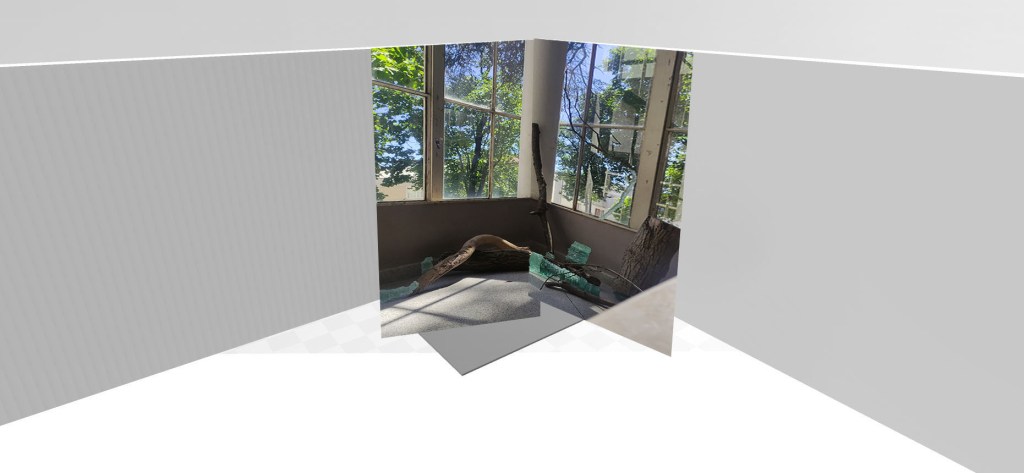
“Cuidado, pode partir!”- O VIDRO E A NATUREZA – O vidro não só como mero material mas enquanto objeto artístico
2022
“Be careful, it might break!”- GLASS AND NATURE – Glass not only as a mere material but as an artistic object
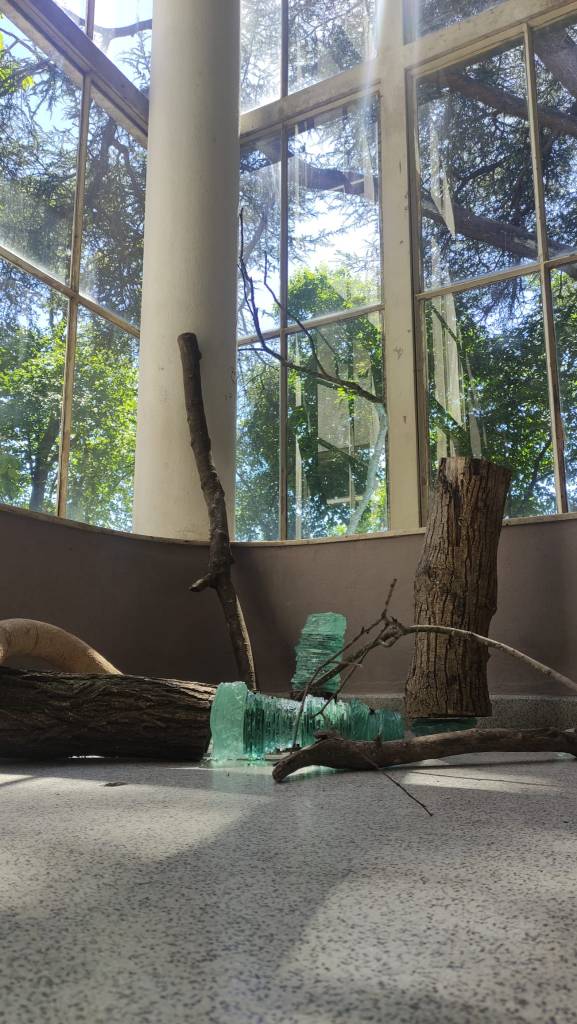
Título: “Cuidado, pode partir!”- O VIDRO E A NATUREZA – O vidro não só como mero material mas enquanto objeto artístico
Ano:2022
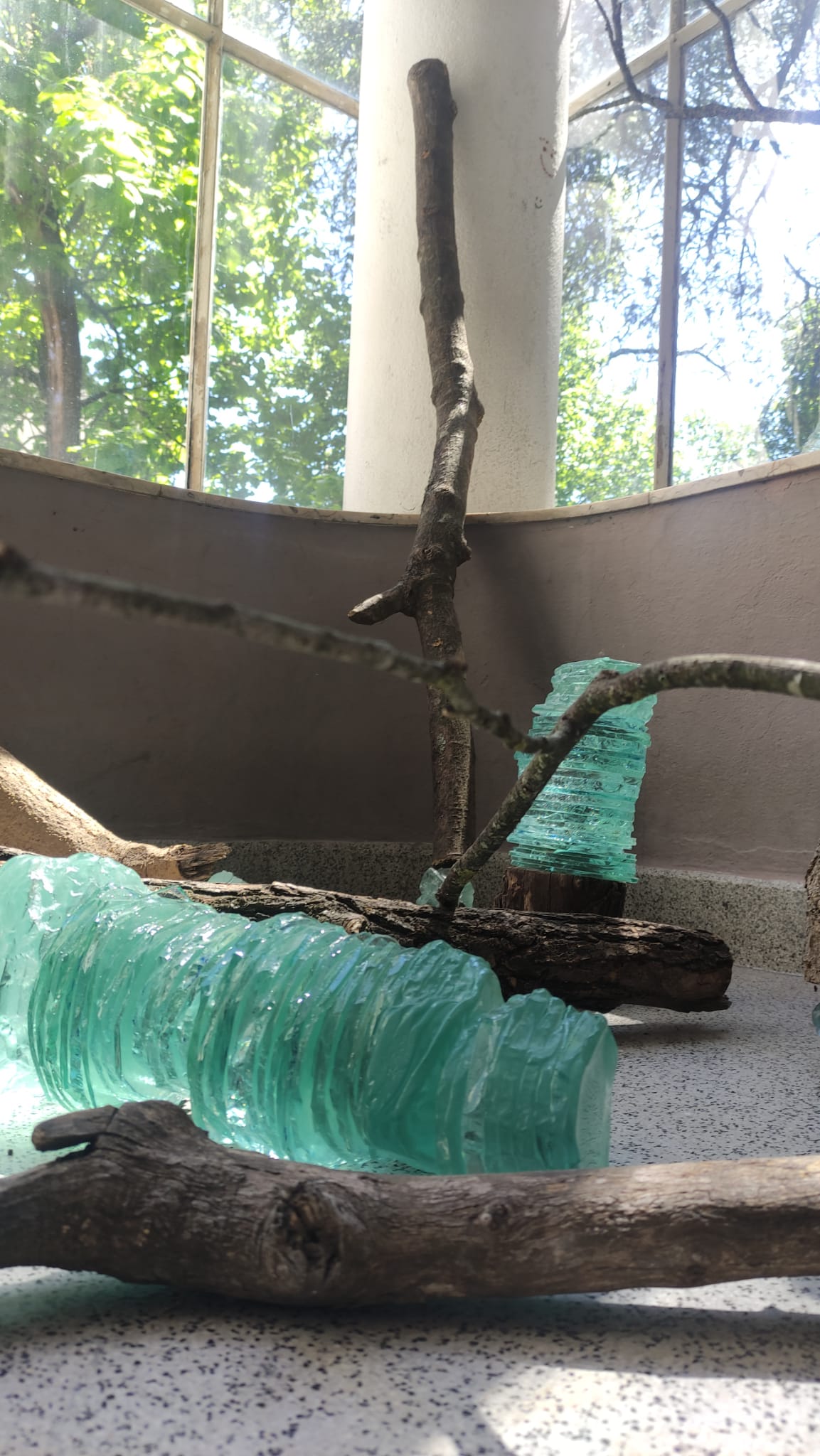
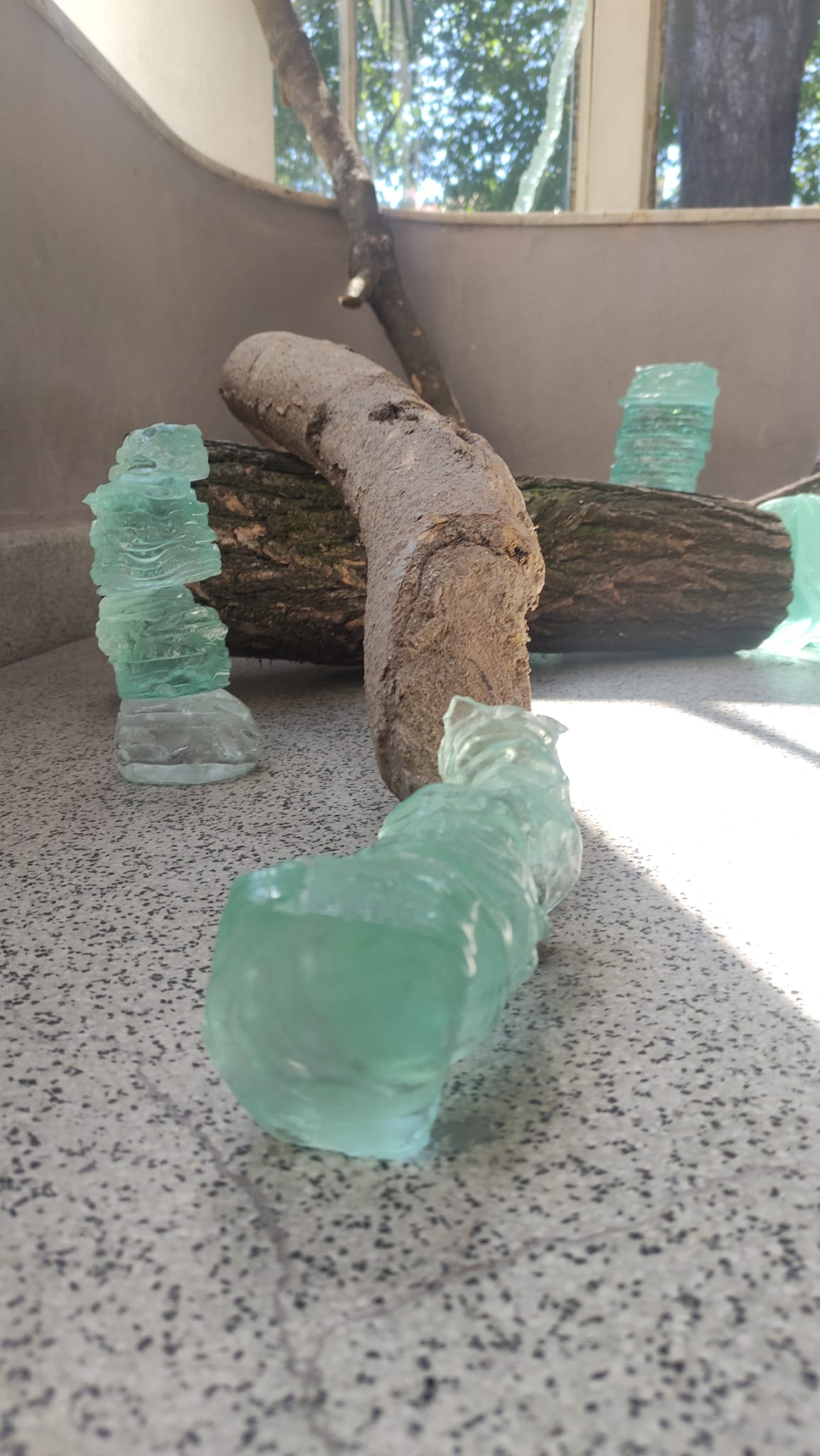
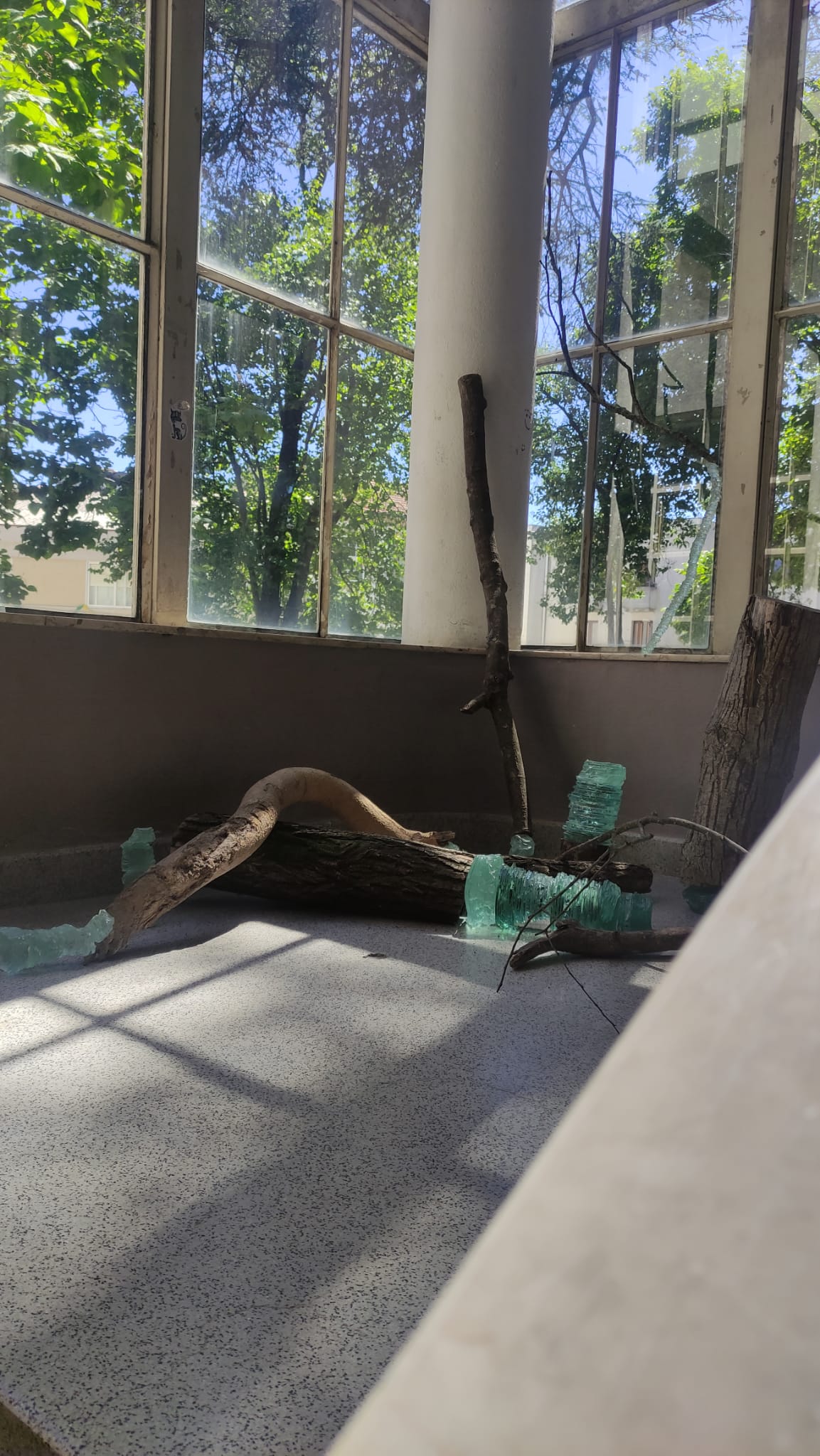
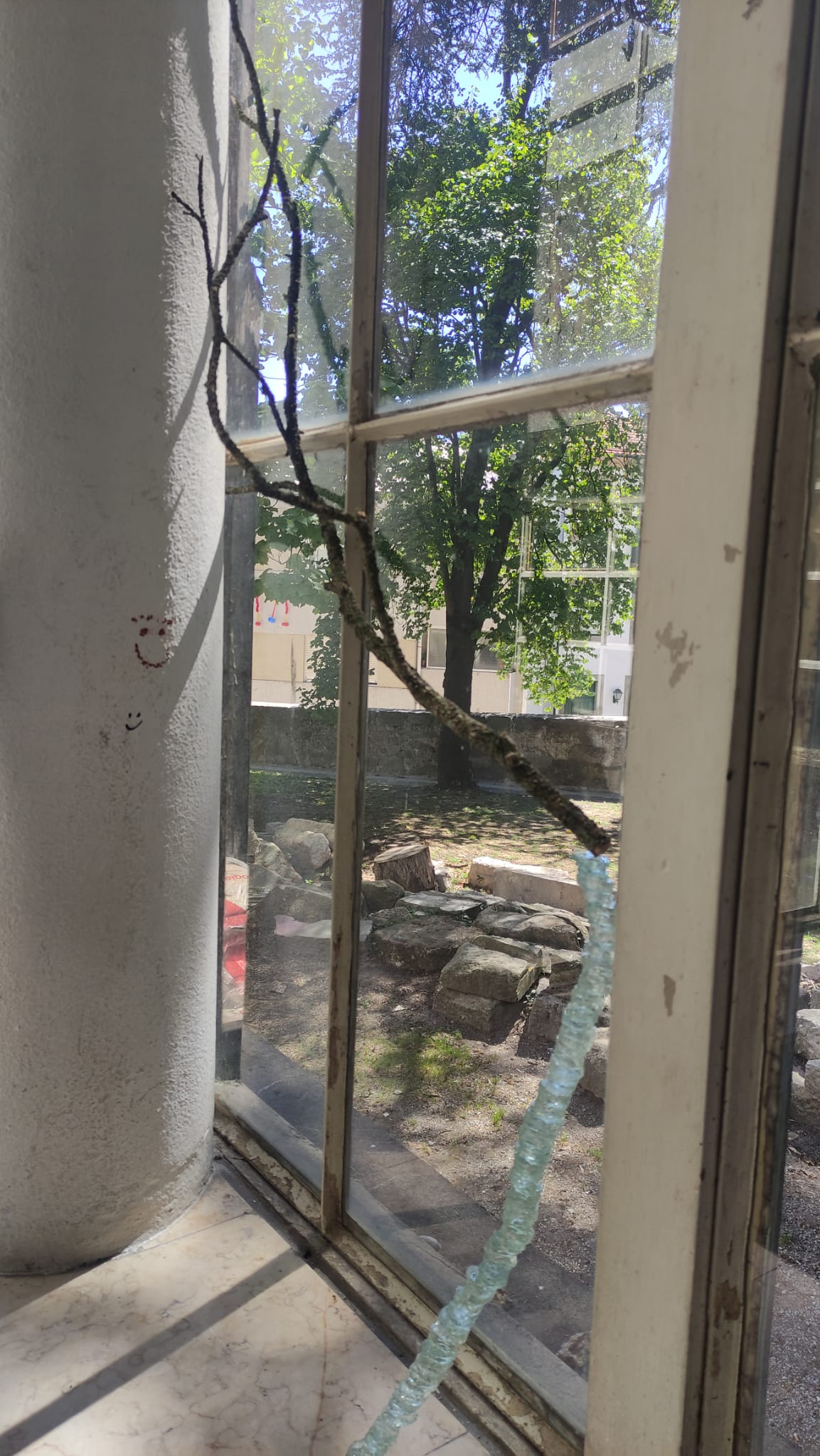
Técnica: Vidro: fusão total, parcial, colagem. Troncos de árvores de carvalho e loureiro.
Características da obra: área de 150 x 150cm. Troncos de carvalho e loureiro e vidro float de 3,4,7,10mm
Sinopse
A presente peça tomará como ponto de partida o encontro do Vidro com toda uma teorização em torno do elemento Memória e sua relação com a minha Avó, a Natureza, o Espaço, a Vida/Morte. Uma arte ecológica onde os elementos arbóreos representarão um papel central e a relação performativa e geométrica de agir e pensar será evidente – do corpo à terra. Assim, direcionarei a minha reflexão ao sentimento de criação do ato estético da vidro, à escultura e pintura em campo expandido enquanto forma e expressão de uma atitude.
Do silêncio ao ruído, do corpo à natureza, do efémero ao perene, esforçar-me-ei por analisar o modo como a desconstrução destes elementos poderá alterar o nosso pensamento quanto ao vidro e sua narrativa quando trabalhado, fundido, gravado, adaptado, silencioso, vivo ou morto. Ao enveredar por este caminho, pretendo evidenciar uma análise da abertura do informal contra o afunilamento do formal.
Palavras-chave: Memória, natureza, vida/morte, avó, espaço
Abstract
This piece will take as its starting point the meeting of Glass with a whole theorization around the Memory element and its relationship with my Grandmother, Nature, Space, Life/Death. An ecological art where arboreal elements will play a central role and the performative relationship and the brain of acting and thinking will be evident – from the body to the earth. Thus, I directed my reflection to the feeling of creating the aesthetic act of glass, to sculpture and painting in an expanded field as a form and expression of an attitude.
From silence to noise, from the body to nature, from the ephemeral to the perennial, I will be anxious to analyze how the deconstruction of these elements can change our thinking about glass and its narrative when worked, cast, engraved, adapted, silent , dead or alive. By embarking on this path, I intend to highlight an analysis of the openness of the informal against the narrowing of the formal.
Keywords: Memory, nature, life/death, grandmother, space
Desde há vários anos que o vidro me inquieta quer pela sua aparente fragilidade – “cuidado, pode partir”- mas simultaneamente resistência. Inquietara-me perceber qual a razão porque tal matéria tinha apaixonado civilizações, continuando a ser suporte de inúmeras expressões e utilizações. Queria entender a sua aparente vulnerabilidade e o desejo de a expor e mostrar, o desejo de continuar a atravessar tempos e culturas, entender este médium enquanto matéria, objeto artístico, símbolo de uma civilização e de um tempo. Sendo a arte um lugar de constante inquietação e desconforto, um lugar de confronto e contemplação, procurei encarar o vidro com um outro olhar, o vidro não pela mera função, mas o vidro enquanto obra artística, enquanto parte integrante da natureza, um veículo para expor os meus medos e receios – o vidro enquanto transparência de mim.
Segundo Tait, já há 5000 anos que o vidro, como material, tem adquirido diversas aplicações, moldando-se ao modo como nos relacionamos com o mundo, quase como se tratasse de uma membrana permeável- ou como escreve Fernando Quintas, “uma membrana protetora”- a estratégias de sedução visual, com o potencial de estender e subverter a visão humana.
Repare-se que, a nível material, o vidro é, desde sempre, associado a operações óticas, contribuindo fulgurosamente para a transformação da ciência, tecnologia, arte e visão. Transparência, translucidez e brilho, são, de facto, características importantes do vidro que o tornaram um material capaz de demonstrar a transformação e os reflexos contínuos da imagem, dependente da luz, das variações climáticas e do movimento do sol. A arte em vidro revela o grande potencial de produzir obras de arte inovadoras e fruição do património pelo público. No entanto, perceba-se que o vidro, pela sua aparente fragilidade tem impedido a maioria dos artistas de empregá-lo em projetos artísticos.
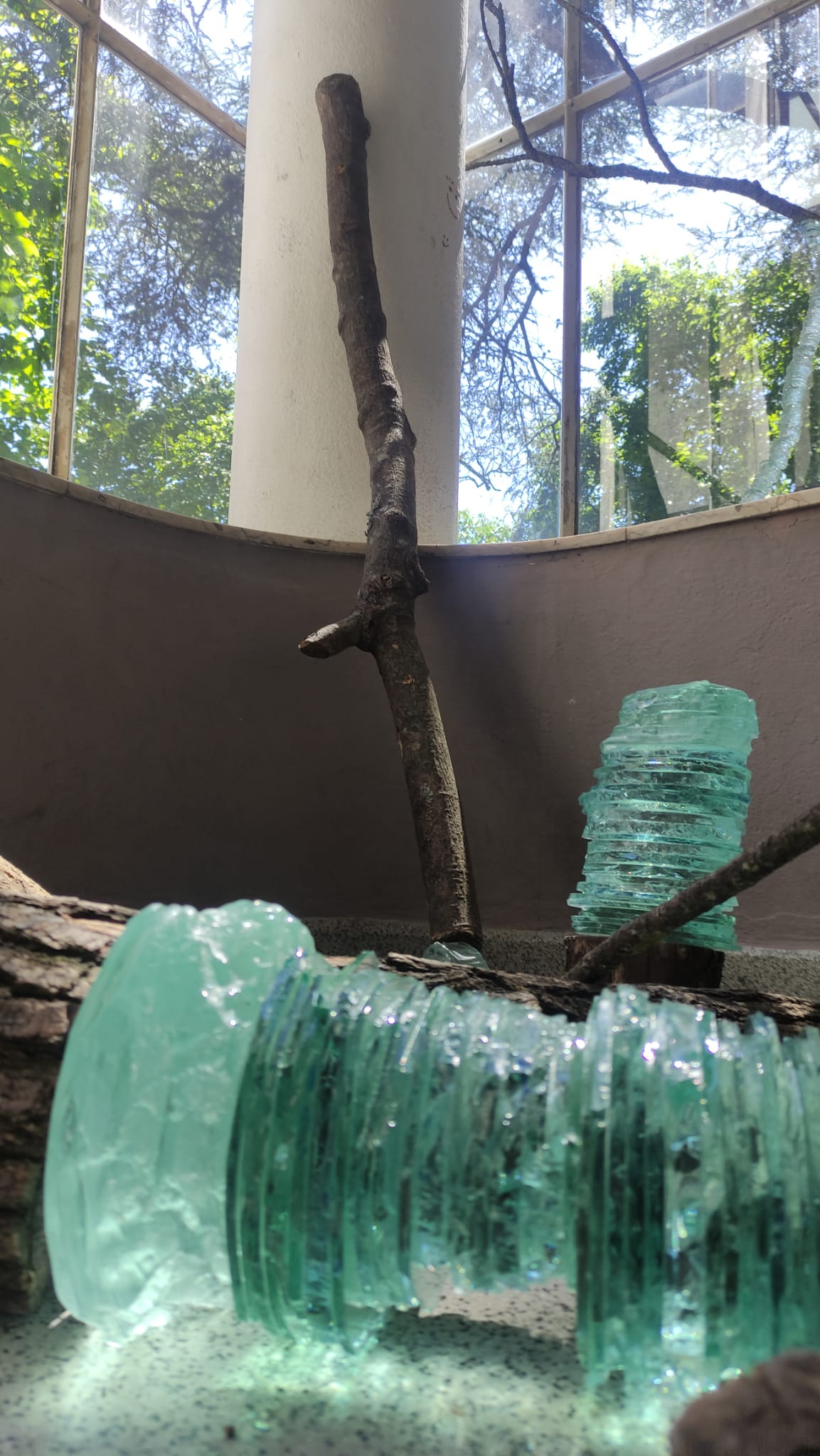
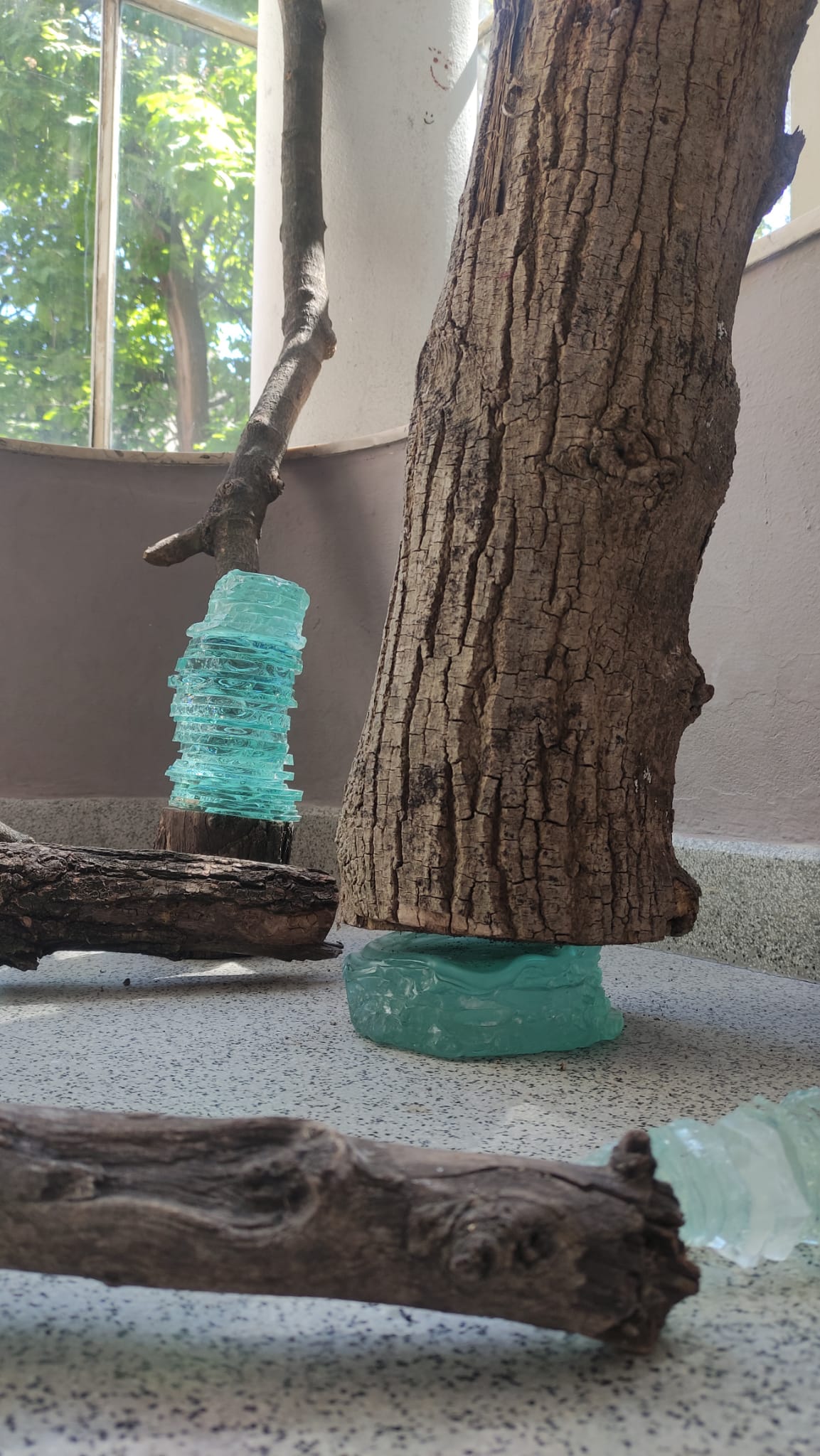
O meu pensamento inicial acerca desta obra recaiu na criação de uma colagem ou fusão de várias placas de vidro que juntas completassem um tronco real simulando a continuação do mesmo em vidro, como se o aparente frágil do vidro se equiparasse à fragilidade da natureza. No entanto, interessava-me também que se sentissem as texturas, que o toque sobre o vidro com seus relevos me tornasse mais próxima do natural.
O projeto assenta em placas de vidro arredondadas não uniformemente, aproximando-se da irregularidade característica da natureza e, ao mesmo tempo, das placas de vidro Petri. Do mesmo modo que estas são usadas em laboratório para observar a evolução dos vários organismos como plantas, animais, microrganismos, interessara-me fragmentar em curvas de nível cada um dos ramos como se várias amostras laboratoriais se tratassem, como se pedaços de um terreno, de uma história, se tratassem. Experimentei vidros de grossuras distintas, desde os 3mm aos 8mm ou até 1 cm. Tentei que fossem encaixando rebeldemente continuando possíveis galhos, troncos de árvore, ramos. Experimentei vidros float de três qualidades distintas, sendo o mais recorrente um esverdeado, pautando-se por um esbranquiçado e terminando num amarelado. Tal irregularidade fazia parte do conceito do projeto, o aproximar o vidro da natureza – será que haveria formas perfeitas na natureza?
Experimentei fundir folhas entre os ramos que acabaram por ficar esbranquiçadas. A meu ver, fiz o que ia sentido que o trabalho precisava. Se no início começara com uma referência clara ao trabalho de Celina Szelejewska-Pigulla, depressa percebi que este era apenas um ponto de partida. Talvez não fosse a questão microscópica o ponto fundamental onde me quereria focar, mas sim o seu formato e ideia de aproximação. Daqui nascem múltiplos desenhos que pretendem confrontar as minhas ideias com as da artista.
Inspirei-me em artistas como Jeremy Sarmiento em suas gravações e seu modo de expor, como se de uma sucessão de fragmentos num esquema dominó se tratasse. “A vida secreta das árvores” de Peter Wohlleben é um livro que acompanha esta investigação e que me faz querer que à semelhança do mesmo, esta proposta procure explicar o que sentem as plantas, qual a sua realidade, enfatizando a cada fragmento a noção de tempo quase como se dos anéis da idade de um tronco se tratassem. Assim como o livro é escrito com textos soltos, pretendi que cada pedaço de vidro contasse uma história, permitindo que o espectador independentemente do local onde começasse a visionar a obra, perceberia a mesma como um todo entre várias partes que se completam. Libertei-me de geometrias e formas perfeitas, queria que cada um dos fragmentos se parecesse a um breve esquisso desenhado.
Depressa me apaixonei pelas suas transparências, pelo modo como a luz o mudava e a influência que as suas sombras e texturas alteravam os modos de o ver. Ao realizar a fusão parcial que face ao tempo que esteve no forno se tornara semelhante a uma total, foi curioso perceber como a simples temperatura tornou o meu trabalho diferente do que esperava, mas curioso pela sua forma gelatinosa fomentada também pelo excesso de papel cerâmico por mim colocado à sua volta.
Desenhei muito, vi muitas referências e fico feliz por ter conseguido alcançar com o vidro o propósito do meu projeto – a natureza e o vidro enquanto fragmentos de memória.
Porque a minha avó era uma apaixonada pela natureza.
Em suma, talvez um simples ramo de árvore abandonado de Alberto Carneiro, aparentemente dispensável, umas simples manchas soltas de James B.Thompson ou formas texturadas como as de Carmen Vetter ou as fusões de imagens microscópicas de Celina Szelejewska-Pigulla ou as paisagens de Pablo Macho sejam o futuro presente do vidro. Pensarmos que tudo já vimos e que o caminho do vidro se esgota no vitral clássico, é, a meu ver, redutor. Repare-se que há lugar na arte do vidro para artistas como Ben Young com suas colagens de oceanos, Danny Lane com suas misturas de materiais ou mesmo Yogo Papadopoulos com seus estilhaços de vidro colados. É impossível não me apaixonar de imediato por artistas como Jon Kuhn e suas rochas de vidro ou mesmo por gravações como as de Alison Kinnaird ou de Jeremy Sarmiento.
A questão que coloco é onde se esgotará o vidro e os modos de o ver e trabalhar? Quais os seus limites? Teremos de ser nós escravos do clássico ou haverá lugar para pensar o vidro enquanto matéria livre de dogmas. É hora de guiarmos os projetos ao limite, o vidro ao mais ínfimo silêncio. Chega! Percebamos que o vidro é muito mais que a simples matéria, o vidro é a transparência, luz, temperatura, uma aparente fragilidade sem frágil o ser!
__
For several years now, glass has disturbed me both because of its apparent fragility – “be careful, it might break” – and its resistance at the same time. It disturbed me to understand the reason why such matter had fascinated civilizations, continuing to support countless expressions and uses. I wanted to understand its apparent vulnerability and the desire to expose and show it, the desire to continue crossing times and cultures, to understand this medium as matter, artistic object, symbol of a civilization and a time. Since art is a place of constant restlessness and discomfort, a place of confrontation and contemplation, I tried to face glass with a different look, glass not for its mere function, but glass as an artistic work, as an integral part of nature, a vehicle for expose my fears and fears – the glass as transparency of me.
According to Tait, for the last 5000 years glass, as a material, has acquired various applications, molding itself to the way we relate to the world, almost as if it were a permeable membrane – or, as Fernando Quintas writes, “a protective membrane ”- to visual seduction strategies, with the potential to extend and subvert human vision.
It should be noted that, on a material level, glass has always been associated with optical operations, contributing brilliantly to the transformation of science, technology, art and vision. Transparency, translucency and brightness are, in fact, important characteristics of glass that make it a material capable of demonstrating the continuous transformation and reflections of the image, dependent on light, climatic variations and the movement of the sun. Glass art reveals the great potential of producing innovative works of art and enjoyment of heritage by the public. However, it should be noted that glass, due to its apparent fragility, has prevented most artists from using it in artistic projects.
My initial thought about this work was the creation of a collage or fusion of several glass plates that together would complete a real trunk simulating its continuation in glass, as if the apparent fragileness of glass was equal to the fragility of nature. However, I was also interested in making the textures feel, that touching the glass with its reliefs made me closer to nature.
The project is based on non-uniformly rounded glass plates, approaching the characteristic irregularity of nature and, at the same time, Petri glass plates. In the same way that these are used in the laboratory to observe the evolution of various organisms such as plants, animals, microorganisms, I was interested in fragmenting each of the branches into level curves as if several laboratory samples were treated, as if pieces of a piece of land, of a story, if they were. I tried different thicknesses of glass, from 3mm to 8mm or even 1 cm. I tried to make them rebelliously fit, continuing possible branches, tree trunks, branches. I tried float glass of three different qualities, the most recurrent being a greenish one, starting with a whitish one and ending in a yellowish one. Such irregularity was part of the project’s concept, bringing glass closer to nature – would there be perfect shapes in nature?
I tried to merge leaves between the branches that ended up being whitish. As I see it, I did what I felt the job required. If at the beginning I started with a clear reference to the work of Celina Szelejewska-Pigulla, I quickly realized that this was just a starting point. Maybe it wasn’t the microscopic question that was the fundamental point I wanted to focus on, but rather its format and idea of approximation. From here, multiple drawings are born that intend to confront my ideas with those of the artist.
I was inspired by artists like Jeremy Sarmiento in his recordings and his way of exposing, as if it were a succession of fragments in a domino pattern. “The Secret Life of Trees” by Peter Wohlleben is a book that accompanies this research and that makes me want that, similarly to the same, this proposal seeks to explain what plants feel, what their reality is, emphasizing in each fragment the notion of time almost as if the age rings of a trunk were treated. Just as the book is written with loose texts, I intended that each piece of glass would tell a story, allowing the viewer, regardless of where he started to view the work, to perceive it as a whole among several parts that complete each other. I freed myself from perfect geometries and shapes, I wanted each of the fragments to resemble a brief drawn sketch.
I quickly fell in love with its transparencies, with the way the light changed it and the influence that its shadows and textures altered the ways of seeing it. When carrying out the partial melting that, in view of the time it spent in the oven, had become similar to a total melting, it was curious to see how the simple temperature made my work different from what I expected, but curious for its gelatinous shape, also fostered by the excess of ceramic paper me placed around you.
I drew a lot, saw many references and I am happy for having managed to achieve the purpose of my project with glass – nature and glass as fragments of memory.
Because my grandmother was passionate about nature.
In short, maybe a simple abandoned tree branch by Alberto Carneiro, apparently expendable, a few simple loose spots by James B.Thompson or textured forms like those by Carmen Vetter or the fusions of microscopic images by Celina Szelejewska-Pigulla or the landscapes by Pablo Macho are the future present of glass. To think that we have already seen everything and that the path of glass ends in classic stained glass is, in my view, reductive. It should be noted that there is a place in glass art for artists such as Ben Young with his ocean collages, Danny Lane with his mixtures of materials or even Yogo Papadopoulos with his glued shards of glass. It’s impossible not to immediately fall in love with artists like Jon Kuhn and his glass rocks or even recordings like those by Alison Kinnaird or Jeremy Sarmiento.
The question I pose is where will glass and the ways of seeing and working with it run out? What are your limits? We will have to be slaves of the classic or there will be room to think of glass as a matter free of dogmas. It’s time to guide projects to the limit, glass to the smallest silence. He arrives! We realize that glass is much more than simple matter, glass is transparency, light, temperature, an apparent fragility without being fragile!